When small business owners come to us for help with their marketing, they almost always ask about the same things. SEO. Google Ads. Meta Ads. Organic social media. Sometimes LinkedIn Ads.
Almost nobody asks about help with email marketing.
I find that fascinating, because email is the one marketing channel I’ve seen consistently deliver results for our own business. And it’s the channel that touches all three levers of The Growth Formula (Traffic, Conversion, and Customer Value) simultaneously. No other channel does that.
We’ve been sending our own email newsletter at Main Street ROI since 2010. It reaches more than 25,000 subscribers today. It has been, without question, the single most valuable marketing asset we’ve ever built. More valuable than our blog. More valuable than our SEO traffic. More valuable than any ad campaign we’ve ever run. More valuable than social media.
And I don’t think that’s unique to us. I think email has that potential for most small businesses. The problem is that most small businesses never give email marketing a real chance.
To be clear, I’m not talking about cold email prospecting or buying a list and blasting out offers. I’m talking about building a list of people who’ve chosen to hear from you, whether they’re prospects who opted in through your website, existing customers, or past customers you haven’t talked to in a while, and staying in touch with them consistently. That’s the version of email marketing that compounds over time, and it’s what this article is about.

How Email Serves All Three Growth Formula Levers
If you’re familiar with The Growth Formula, you know that sustainable growth comes from three levers working together: Traffic, Conversion, and Customer Value, with Tracking as the foundation.
Most marketing channels are strong on one lever. SEO is primarily a Traffic play. A landing page redesign is primarily a Conversion play. A loyalty program is primarily a Customer Value play. There’s nothing wrong with that. But email is rare because it contributes meaningfully to all three at the same time.
Traffic: A free visit button you can press any time you want.
Every time you send an email to your list, you generate website visits from people who already know you. No ad spend. No algorithm. No hoping Google ranks your page. You write something valuable, hit send, and people show up.
That matters more than most business owners realize. If you publish a blog post and nobody sees it, it doesn’t matter how good it is. If you launch a new service and your website is the only place it’s mentioned, you’re waiting for someone to stumble across it. An email list gives you the ability to drive traffic on demand, to the pages that matter most, whenever you need to.
And unlike paid traffic, where every click costs money, email traffic is essentially free after the initial investment in building the list. The more subscribers you have, the more valuable every send becomes.
Conversion: Turning a visit into an ongoing relationship.
Here’s a reality that most small business owners don’t think about enough: the vast majority of people who visit your website are not ready to buy today. They might be researching. They might be comparing options. They might just be curious. If the only conversion action on your site is “Call Us” or “Request a Quote,” you’re losing everyone who isn’t ready for that step yet.
An email signup changes the equation. It converts a one-time anonymous visit into a relationship. That person might not need you today, but when they do need a dentist, a roofer, an accountant, or whatever you do, you’ll be the one who’s been showing up in their inbox with helpful information for the last three months.
Over the years, I’ve seen this play out with our own subscribers. Someone joins the newsletter, reads it for weeks or months, and then reaches out when they’re ready. By that point, they already trust us. The sales conversation is completely different from a cold lead who found us through an ad five minutes ago.
Customer Value: The lever most businesses ignore entirely.
This is where email really separates itself, and where most small businesses leave the most money on the table.
Getting a new customer is expensive. It takes time, effort, and usually money. But staying in touch with the customers you already have? That’s practically free. And the return is enormous.
A simple monthly email to your existing customers can drive repeat purchases, remind people about services they haven’t used, generate referrals, and reactivate customers who haven’t come back in a while.
We published two case studies that show exactly what this looks like in practice. A chiropractor generated $1,000 from a single email to just 45 dormant leads. A medical device company generated $20,000 from a campaign to 14,000 past customers. Neither list was being used at all before those campaigns. The revenue was just sitting there, waiting for someone to send an email.
Customer Value is often the most overlooked lever in The Growth Formula. Email is the easiest way to start improving it.
The Bank Account Principle
So if email is this valuable, how should you approach it?
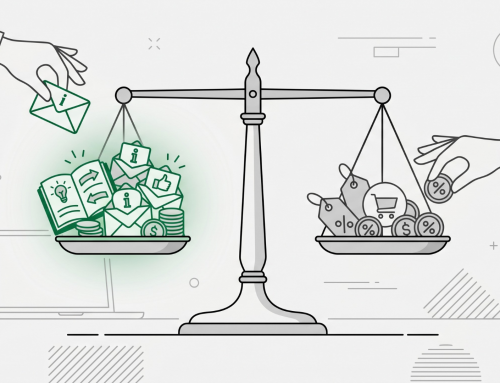
I think about email marketing the way I think about a bank account. Before you can make a withdrawal, you need to have made enough deposits to cover it.
Every time you send your subscribers something genuinely useful (a helpful tip, an honest answer to a common question, a resource they can actually use) you’re making a deposit. You’re building trust. You’re reinforcing the idea that your emails are worth opening.
Every time you send a promotional email (a sale, a special offer, a pitch for your services) you’re making a withdrawal. You’re spending some of the trust you’ve built up.
Both deposits and withdrawals are necessary. You’re running a business, not a charity. But the balance has to stay positive. If every email you send is a promotion, people stop opening them. They unsubscribe. Or worse, they just tune you out.
The businesses that do email well make far more deposits than withdrawals. They send helpful content consistently, and when they do make an ask, their audience is receptive because there’s trust in the account.
Here’s the part that trips people up: consistency matters more than frequency. Sending a valuable newsletter once a month, every month, is better than sending three emails one week and then going silent for two months. A sporadic email list loses trust not because the content is bad, but because the pattern is unreliable. Your subscribers don’t know what to expect, so they stop expecting anything.
Pick a frequency you can actually sustain. Monthly is fine. Biweekly is great. Weekly is ideal if you have enough to say. The cadence matters less than the commitment to maintaining it.
The 4 Biggest Email Marketing Objections (and Why They’re Wrong)
I want to be honest about the objections, because I hear them all the time.
“I don’t want to annoy people.” This is the most common one. And I understand it, because nobody likes getting spammed. But there’s a big difference between spam and a genuinely helpful email from a business you chose to hear from. If you’re following the Bank Account Principle and making deposits before withdrawals, you’re not annoying anyone. You’re providing value.
“I don’t know what to write about.” You know more about your business and your industry than your customers do. The questions your customers ask you every week? Those are emails. The mistakes you see people make? Those are emails. The seasonal advice you give every year? Those are emails. You don’t need to be a professional writer. You just need to be helpful.
“It feels like a lot of work.” It can be, if you overthink it. But a simple monthly email with one useful tip, one update about your business, and one clear call to action can be written in an hour. Compare that to the cost of running ads or the time it takes to see results from SEO, and the return on your time is hard to beat.
“We’ve tried it before and it didn’t work.” In my experience, this usually means one of two things: either the business sent a few emails, didn’t see immediate results, and stopped (which is the consistency problem), or every email was a promotion with no deposits in the account (which is the Bank Account problem). Both are fixable.
Where Email Fits in Your Marketing Mix
Email is not a replacement for your other marketing channels. It’s the connective tissue that makes them all work better.
Think about it this way. SEO and Google Ads drive new visitors to your website. That’s traffic. Your website converts some of those visitors into leads and customers. That’s conversion. But what about everyone who visited and wasn’t ready to act? Without email, they’re gone. With email, they stay in your orbit.
Your blog content performs better because you have an audience to send it to. Your promotions perform better because you’ve built trust through consistent value. Your customer retention improves because you’re staying top of mind.
If you think of your marketing like an investment portfolio (which we’ve written about before), email is the compounding asset. It doesn’t produce dramatic short-term results. But over months and years, a growing, engaged email list becomes one of the most valuable things your business owns. And unlike your social media following or your ad account, your email list is something you actually own. No algorithm change or platform policy can take it away from you.
The Bottom Line
Email is the most underrated channel in The Growth Formula. It drives traffic without ad spend, converts visitors into long-term relationships, and increases the lifetime value of every customer. It works for practically every industry and practically every budget.
You don’t need to email daily. You don’t need to be a great writer. You don’t need a massive list to start. You just need to start making deposits and stay consistent.
If your email list is collecting dust, or if you don’t have one yet, that’s not a small gap in your marketing. It’s one of the biggest opportunities you’re not taking advantage of.
Need Help With Your Digital Marketing?
If you’re not sure where email fits in your overall marketing strategy, or you want help figuring out which lever of The Growth Formula needs the most attention, we can help you figure that out.
Click here to request a free strategy call.
Related Reading: