Think about how you manage your money.
If you have a retirement account, a 401(k), an IRA, or even just a savings plan, you probably don’t dump everything into one stock and hope for the best. You don’t pull all your money out every time the market dips. And you don’t expect to invest $500 and retire a millionaire.
You plan. You diversify. You stay patient. And ideally, you have someone you trust helping you make smart decisions … a financial advisor, not a salesperson pushing the product with the highest commission.
Now think about how most small business owners manage their marketing.
They put everything into one channel and hope it works. They pull the budget when things get tight. They expect huge returns from tiny investments. And they hire whoever sounds the most convincing, without a framework to evaluate whether the advice is any good.
See the disconnect?
The shift we need to make is simple, but it changes everything: stop thinking about marketing as a cost to minimize, and start thinking about it as an investment to manage.
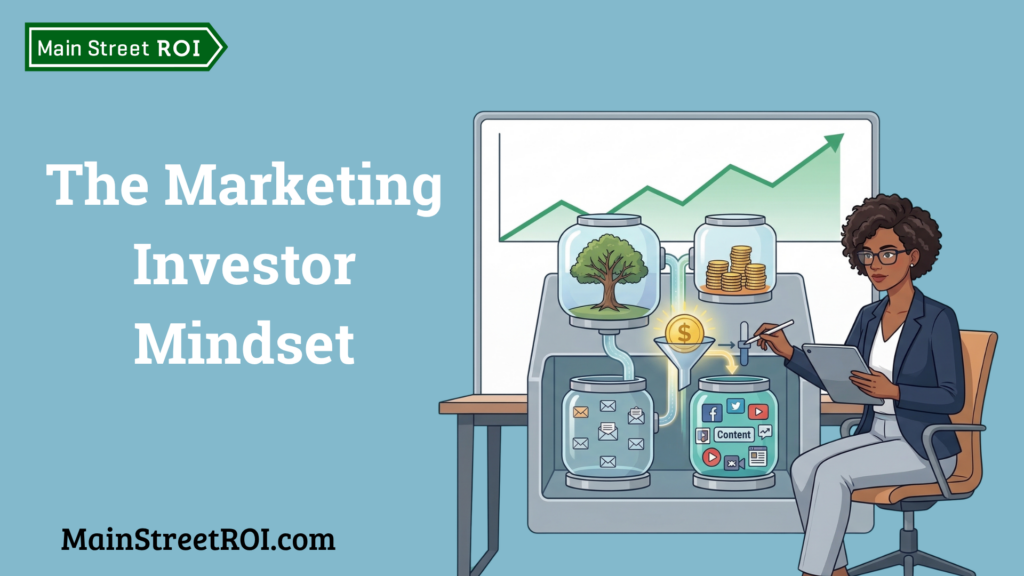
What Changes When You Think Like an Investor
When marketing is a cost, you try to spend as little as possible. You cut it when things are tight. You evaluate it by asking “how much did that cost?” instead of “what did that produce?”
When marketing is an investment, everything shifts. You start asking different questions:
- Where should I put my next dollar to get the best return?
- Am I diversified enough, or am I too dependent on one source?
- What’s working, and should I put more into it?
- What’s underperforming, and should I cut it or give it more time?
- Do I have the right people helping me make these decisions?
These are the same questions a smart financial investor asks about their portfolio. And they’re exactly the right questions to ask about your marketing.
Plan for the Long Term
No serious investor puts money into the market without a goal. Are you saving for retirement in 20 years? Funding your kid’s college in 10? Building an emergency fund? The goal determines the strategy.
Marketing works the same way. If you want to grow by 10% this year, that’s one plan. If you want to double your revenue in three years, that’s a very different plan with a different budget, different timeline, and different expectations.
Most of the business owners I talk to have a vague sense of “I want to grow.” But they haven’t attached a number to it. They haven’t connected that number to a marketing investment. And they haven’t thought about what it will take to get there over one, two, or three years.
That’s like saying “I want to retire comfortably” without ever calculating how much you need to save. The intention is great. But without a plan, it stays an intention.
Diversify to Reduce Risk
You wouldn’t put your entire retirement savings into a single stock. If that stock tanks, you lose everything. So you spread your money across different types of investments to reduce your exposure to any single failure.
The same principle applies to marketing. If all your leads come from one source, whether that’s referrals, Google Ads, or SEO, you’re concentrated in a single position. And when that position gets disrupted, you’re in trouble.
We’ve seen this happen. One of our clients lost 100% of their paid leads overnight when their Google Ads account got suspended over a policy issue that took weeks to resolve. Another business owner came to us after a web developer botched their site redesign and forgot to set up redirects. They’d lost 70% of their organic search traffic, and had no other channels generating leads to fall back on.
Phil and I learned this lesson firsthand. Before we started Main Street ROI, we worked at a small company that relied almost entirely on Google Ads for leads. It worked well for a while. But over time, the space got more competitive, costs went up, and lead quality fluctuated. We were on the Google Ads rollercoaster with no seatbelt.
Then we discovered the power of email marketing. We started sending a newsletter and running email campaigns to stay in touch with leads who weren’t ready to buy right away. Over time, those leads converted. That did a few things for us: it improved the long-term return on our Google Ads investment because leads we’d already paid for were now converting months later, it smoothed out the feast-or-famine cycle, and it gave us a second channel that didn’t depend on ad spend. That experience stuck with both of us and shaped how we think about marketing to this day.
Think of it like a financial portfolio: some short-term holdings that produce income now (like Google Ads), and some long-term holdings that build value over time (like SEO and content). The mix depends on your business, your budget, and your goals. But the principle is the same: don’t put all your eggs in one basket.
Reallocate Based on Results
Smart investors don’t just set up a portfolio and forget about it. They review it. They rebalance. If one investment is outperforming, they may put more into it. If another is consistently underperforming, they cut it and redirect those funds somewhere better.
This is exactly how your marketing should work. But it requires one thing that most small businesses don’t have: visibility into what’s actually producing results.
When you’re tracking your marketing properly, you can see which channels are generating leads, which leads are turning into customers, and how much you’re paying for each one. With that information, reallocation becomes straightforward. You put more money where the returns are strong, and you pull back from what isn’t working.
Without tracking, you’re guessing. And most business owners, when they’re guessing, either keep spending on everything equally or cut the thing that feels most expensive, regardless of whether it’s actually their best performer.
The investor mindset says: don’t guess. Measure, evaluate, and reallocate. Quarterly at minimum. That’s how portfolios grow, and that’s how marketing grows.
What This Looks Like in Practice
Let me give you a real example.
Jordan runs a fence company here in Connecticut. When we first started working together, he had a couple of crews and was doing roughly a million dollars a year, built mostly on hustle and referrals. He’s a hard worker and a natural salesman. But he didn’t have a real marketing system.
We built a plan together, and we were intentional about the sequence. First, we set up an SEO foundation to improve his visibility in search. That takes time to build, but it compounds. Once that was in place and gaining traction, we layered in Google Ads to generate leads while the organic rankings continued to grow.
Over the next few years, Jordan grew to four crews and doubled his revenue, then doubled it again as he took on more commercial work. The phased approach worked because each investment built on the one before it, just like adding to a portfolio over time.
Then we went our separate ways for a while. Jordan brought in another firm that redesigned his website and ran his advertising. The website looked great. But when Jordan came back to us for an audit, he couldn’t tell us which of his marketing efforts were actually producing leads. He’d been spending $5,000 to $10,000 a month on ads, sometimes even through the off-season, with no call tracking, no clear attribution, and no way to know whether that spend was generating revenue or just burning cash.
That’s not investing. That’s hoping.
When we reconnected, the first thing we did was set up proper tracking so Jordan could actually see what was working. Then we rebuilt his Google Ads campaign with a focused strategy, trimmed the waste, and immediately started getting better results at lower cost.
And here’s the part that stuck with me. One of the first things Jordan asked for once we had his tracking in place was a quarterly review. Every 90 days, we sit down and look at what’s working, what’s not, and whether his marketing investments need to shift. Jordan didn’t learn that from us. He asked for it, because once you start thinking like an investor, you naturally want to check on your portfolio.
You Don’t Have to Do This Alone
There’s a well-known concept in business: the difference between working in your business and working on your business. Most small business owners spend nearly all of their time in the business, delivering services, managing staff, putting out fires. Very little time gets spent on the business, thinking strategically about where it’s headed and how to get there.
Marketing is one of those “working on the business” activities that gets squeezed out. It feels important but never urgent, right up until the pipeline dries up and it becomes the most urgent thing in the world.
The investor mindset doesn’t mean you have to become a marketing expert. It means you need to think about your marketing the way you’d think about your financial portfolio. Set goals. Allocate a budget. Diversify. Track results. Rebalance periodically.
And just like a financial investor might work with a trusted advisor to stay on track, having someone who helps you stay strategic with your marketing can make a real difference. Someone who knows the landscape, reviews your numbers with you, and helps you make smart allocation decisions.
A Quick Self-Assessment
Before you close this article, take two minutes with these questions. They don’t need perfect answers. They just need honest ones.
1. What’s your growth goal? How much revenue did your business generate last year? What’s your target for the next 12 months? If you don’t have a specific number, that’s useful information. It means your marketing has no target to aim at.
2. What are you investing? Add up everything you spend on marketing each month: ad spend, agency fees, tools, content, design. Multiply by 12. Then divide by your annual revenue. That’s your marketing investment rate. If you want aggressive growth but you’re investing 1% of revenue, there’s a gap.
3. Can you answer these three questions? Do I know where my best leads come from? Am I overly dependent on one channel? Could I explain to someone else what my marketing is doing and whether it’s working? If you answered “no” to any of those, you’re not alone. Most business owners can’t.
The good news is that these are all fixable. And the fix starts with the mindset shift we’ve been talking about: treat your marketing like an investment, not an expense.
Watch: The Marketing Investor Mindset
Want to hear more about this concept? In this short video, our team member Riley McLaughlin walks through the Marketing Investor Mindset and how it applies to your business.
Need Help Managing Your Marketing Investment?
If you’re ready to stop guessing and start managing your marketing like the investment it is, we can help. Request a free strategy call, and we’ll review your goals, current marketing, and budget to recommend the best next steps for growth.
You’ll come away with clear, practical advice, whether or not you decide to work with us.